
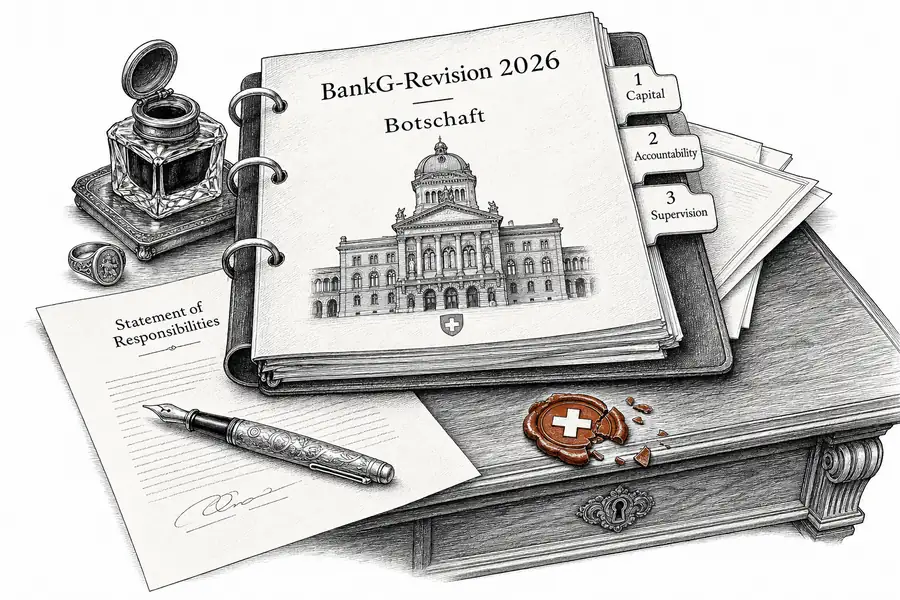
TBTF, Take Three: Capital, Accountability, Supervision in the BankG-Botschaft
The Bundesrat's Botschaft on the BankG-Revision arrived on 22 April 2026 carrying three measures: USD 20 billion of additional CET1, a Senior Manager Regime, and a FINMA Bussenkompetenz. Together they re-paper the Verwaltungsrat's relationship to its supervisor under Swiss federal law. Two near-term events — the Ständerat vote and FINMA's first publication under the new aktive Kommunikationskompetenz — will preview how the Revision actually reads.
Casimir von Firn, MLaw
The Bundesrat tabled its Botschaft on the BankG-Revision on 22 April 2026 carrying three measures of comparable weight: USD 20 billion in additional CET1 capital for UBS at parent level (Basel III, IFRS-reported), a Senior Manager Regime anchored in named Statements of Responsibilities, and a FINMA Bussenkompetenz the agency has been signalling for three years. The Verwaltungsrat is no longer the document’s audience — it is now a named party to it.
The Revision is, in substance, a contractual-risk reallocation under Swiss federal law dressed as a banking-stability bill. The Bundesrat, having spent two years drafting around the Credit Suisse resolution, did not write a new statute; it amended the BankG with carve-outs that track the December 2023 PUK-Bericht recommendations. The more revealing drafting choice is what the Botschaft omits: bonus clawback survives at the level of the Vergütungsverordnung and FINMA-Rundschreiben, not in the statute itself. The discipline lever is structural, not financial.
The three measures
1. Capital. Article 9 BankG, re-drafted in concert with the Eigenmittelverordnung effective 1 January 2027, requires systemically important banks to back participations in foreign group entities one hundred per cent with hard core capital. Full CET1 deduction, no AT1 substitution. The Federal Department of Finance estimates the change requires UBS AG to hold approximately USD 20 billion in additional parent-level CET1, phased in across a seven-year transition. UBS, in its 22 April 2026 statement, put the total marginal CET1 exposure — including Credit Suisse integration carry-overs — at roughly USD 37 billion, with annualised capital costs of about USD 3 billion. Both figures draw from UBS’s balance sheet as of 31 December 2025, IFRS-reported, and have not been independently audited.
2. Accountability. The Senior Manager Regime adopts the UK and EU model in attenuated form. Each senior executive signs a Statement of Responsibilities; the institution maintains a Management Responsibilities Map. The drafting is narrower than the UK SMCR — it captures the Verwaltungsratspräsident, the members of the Geschäftsleitung, and persons holding Schlüsselfunktionen without formal officer title. The Botschaft leaves the perimeter of Schlüsselfunktion to FINMA. How FINMA draws that perimeter — through a Rundschreiben before the first enforcement decision, or case by case in proceedings — will determine how much of the regime bites in practice.
3. Supervision. FINMA receives three new instruments: a Bussenkompetenz (pecuniary administrative sanctions, primarily institutional), an early-intervention power that operates before a stability breach materialises, and an aktive Kommunikationskompetenz — a statutory licence to publicise concluded proceedings. The third instrument is the quietest and has the longest reach. A FINMA enforcement record the public can read touches disclosure controls and counterparty contracts at every authorised institution, not only at the one named in it.
What the Verwaltungsrat now signs
The current BankG already places organisational duties on the Verwaltungsrat through Article 3 (Bewilligungsvoraussetzungen) and the doctrine of Gewähr für eine einwandfreie Geschäftstätigkeit. The Revision does not relocate those duties — it re-papers them. The same Verwaltungsrat signs a Statement of Responsibilities mapped against a published Responsibilities Map, and any future FINMA enforcement decision will name the natural persons holding each function.
Two operational consequences follow. The Senior Manager Regime captures delegation only to the extent it is documented in the Map; an undocumented hand-off of a Schlüsselfunktion does not transfer responsibility within the meaning of the BankG. And Risk Committee minutes that record an unaddressed risk become potential evidence in a later FINMA decision applying Art. 33 FINMAG to the individual who held the named function. The Berufsverbot under Art. 33 FINMAG operates through a FINMA decision subject to appeal to the Bundesverwaltungsgericht; the sanction is administrative rather than criminal, but it ends the person’s regulated career. D&O cover would have to respond, but no Vernehmlassung-period insurer pricing is yet on the public record — the consultation covered the statute, not its insurability.
Where the FINMA powers sit
The Bundesrat could have routed the fining power through the FINMAG (Article 36 et seq.) and left the BankG untouched. It chose otherwise. The Bussenkompetenz lives in the BankG itself because the fines reach institutions whose authorisation lives there. That places licence and sanction in the same statute, which is unusual Swiss drafting.
The aktive Kommunikationskompetenz is drafted as a counter-rule to the Aufsichtsrechtliche Schweigepflicht under Article 14 FINMAG. The Botschaft ring-fences the new power to concluded proceedings and requires FINMA to weigh proportionality. The Bundesverwaltungsgericht’s first ruling on the meaning of “concluded” will set the working perimeter; in the meantime, FINMA’s first publication under the new power will tell the market how the agency itself reads it. The same interpretive question is also live in the AT1 cases now pending at Bundesgericht, where FINMA and UBS are contesting the Bundesverwaltungsgericht’s October 2025 ruling on the AT1 write-down. The Botschaft deliberately left AT1 reform out of scope, pending development of international standards.
What resolves the open questions
The Botschaft is firm on the capital measure. UBS argues that USD 20 billion at parent level prices Swiss systemic risk for the domestic taxpayer without crediting the resolvability work already booked under the FINMA-approved Recovery and Resolution Plan. UBS was not alone in the Vernehmlassung: cantons, political parties and industry associations broadly opposed the capital measure on Swiss Finish and competitive-disadvantage grounds, as documented in the Homburger analysis. The Bundesrat’s response: double leverage is a structural defect Switzerland flagged internally in 2012, and a seven-year phasing tolerates the carry. The weaker piece is sequencing — seven years runs through the next federal election cycle, two SNB monetary policy reviews and at least one further Basel calibration round.
Two near-term events will preview how the Revision actually reads. The first is the Ständerat vote on the capital measure, expected in the autumn 2026 session; the first chamber’s position will set the bargaining range for the National Council. The second is FINMA’s first published enforcement decision under the aktive Kommunikationskompetenz, which will fix the agency’s working definition of “concluded” before any court reaches it. Both will land before the Bundesverwaltungsgericht has weighed in on either. They will tell the Verwaltungsrat more about what the Revision means in practice than the closing paragraph of the Botschaft does.